Collagen, MSM, Turmeric — What's Marketing and What's Evidence

You look at the back of a joint supplement and there's glucosamine and chondroitin — fair enough, you've heard of those — and then another fifteen ingredients with names that sound like the periodic table. "Enhanced with collagen peptides and MSM." "Now with turmeric extract." "Patent-pending bioavailability complex."
You've got no idea if any of that means anything. You just know your knees hurt and the marketing sounds convincing.
This is the piece that tells you what actually works and what's mostly there to justify the price.
The Problem With Joint Supplement Labels
Joint supplement formulas have exploded over the last decade. Twenty years ago you got glucosamine or you got chondroitin sulphate, maybe both together if you paid a bit more. Now the same bottle includes eight additional ingredients, each with its own promise on the front of the packet.
Some of those additions have real evidence behind them. Some are biologically plausible but underdosed to the point of uselessness. Some are effectively marketing — a trendy name on the label that looks good to someone scrolling Amazon reviews but delivers nothing to your actual cartilage.
The challenge is that supplement manufacturers aren't required to prove their formulas work. They can include any ingredient at any dose as long as they don't make an outright medical claim. "Supports joint health" is legal. "Cures arthritis" is not. Everything lives in the space between those two statements, and most of it is designed to sound more impressive than it is.
What follows is an honest breakdown of the three most common additions you'll see on joint supplement labels: collagen, MSM, and turmeric. For each one, I'll give you the evidence level, what dose actually matters, and what the marketing usually hides. No product flogging. No brand mentions. Just what the research says and what you should look for if you're spending money on this stuff.
Collagen: Plausible, Often Underdosed
Collagen is the structural protein in cartilage, tendons, ligaments, and skin. Your body makes it naturally. The logic of supplementing it is straightforward: you're giving your body the building blocks it needs to repair the tissue you're damaging daily.
The evidence here is medium. Not outstanding, not nonsense — somewhere in the middle depending on which form of collagen you're talking about.
Type II Collagen (UC-II)
There's a specific form called undenatured type II collagen, often listed as UC-II on labels. Studies show 40mg per day reduces pain and improves mobility in people with osteoarthritis. The mechanism appears to be immune modulation rather than just providing raw materials — your gut processes it in a way that reduces inflammation in the joints specifically.
40mg is a small dose. If a product lists UC-II or undenatured type II collagen and gives a specific milligram amount around that number, it's probably doing what the research suggests it should.
Hydrolysed Collagen
This is the more common form — collagen that's been broken down into smaller peptides so it's easier to absorb. It shows up on labels as "hydrolysed collagen", "collagen peptides", or sometimes "marine collagen" if it's sourced from fish rather than cows.
Hydrolysed collagen provides amino acids your body uses to make cartilage: glycine, proline, hydroxyproline. The theory is sound. You're giving the repair process what it needs. The evidence is less clear because there's debate over whether your body actually directs ingested collagen preferentially to joints or just uses it as generic protein.
The bigger issue is dose. Most studies showing benefit use 10-15 grams of hydrolysed collagen per day. That's a lot. Many joint supplements include 1-5 grams, sometimes less. At that level you're getting some amino acids but probably not enough to shift the needle.
One more detail: collagen synthesis requires vitamin C as a co-factor. If a formula includes collagen but no vitamin C, it's either incomplete or relying on you getting enough from your diet. Most tradesmen I know aren't eating citrus fruit at breakfast, so that's worth noting.
Verdict on Collagen
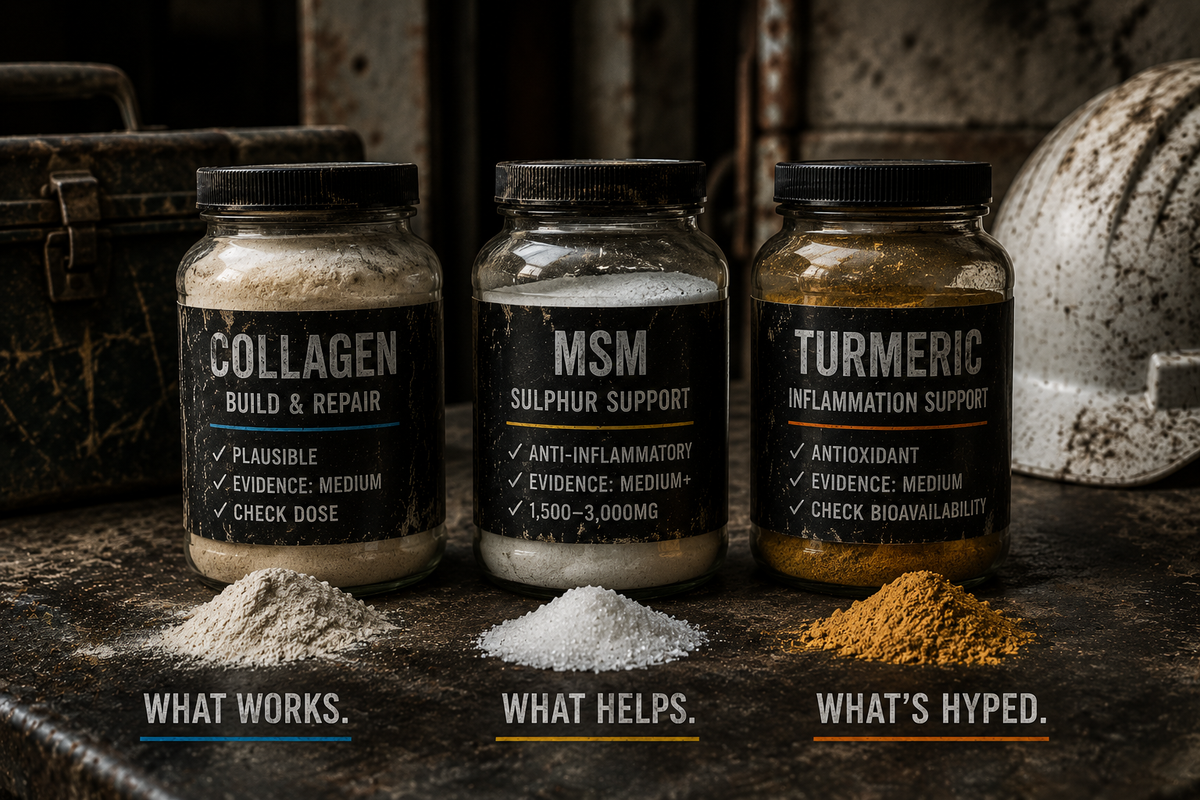
Biologically plausible. Reasonable supporting evidence, especially for UC-II. Often underdosed in cheap formulas. If you're buying a product for collagen content specifically, check the dose and check whether it includes vitamin C. If the label says "with collagen" but doesn't tell you how much or what type, it's probably marketing.
MSM: Boring Name, Decent Evidence
MSM stands for methylsulfonylmethane, which is why everyone just says MSM. It's a sulphur-containing compound. Sulphur is a component of cartilage and connective tissue, and MSM appears to have anti-inflammatory properties on top of providing that raw material.
The evidence here is medium, leaning toward the better end of medium. Several human trials show pain reduction and improved function at doses of 1,500-3,000mg per day. It's often paired with glucosamine because the sulphur component seems to complement it — one supplies the building blocks, the other helps manage inflammation.
There was a sparky I worked with in Manchester around 2016 called Paul. Late forties, wrists absolutely wrecked from thirty years of twisting cable. He'd started taking MSM after reading about it on some forum — 2,000mg twice a day, he said. I asked him if it worked. He shrugged and said, "Can't tell you it's a miracle, but I'm still working and the bloke who started the same time as me packed it in last year. Make of that what you want." That's about as good as testimonial evidence gets in the real world — maybe it helped, maybe he just got lucky with his genetics, but he wasn't making any wild claims.
MSM has a good safety profile. Very few reported side effects. It's cheap to manufacture, so it's not usually the ingredient driving up the price of a formula. If you see it listed at 1,500mg or above, it's dosed in line with what the research used. If it's in there at 200-500mg, it's probably decorative.
Verdict on MSM
Reasonable evidence. Good safety profile. Sensible addition at the right dose. Not going to reverse twenty years of damage, but may take the edge off inflammation if you're taking enough of it. Look for 1,500-3,000mg per day total.
Turmeric: Good Science, Terrible Marketing
Turmeric is where the gap between evidence and marketing is widest.
Curcumin — the active compound in turmeric — is a genuinely potent anti-inflammatory. Studies in cells and animals show it reduces the kind of inflammatory signalling that drives joint pain. Human trials back that up: doses of 500-2,000mg of curcumin per day show benefit for osteoarthritis pain, comparable in some studies to ibuprofen.
So far, so good. The problem is bioavailability and labelling dishonesty.
The Bioavailability Problem
Standard curcumin is poorly absorbed by the gut. You can swallow 500mg of it and only a tiny fraction makes it into your bloodstream. The rest passes through unused.
The fix for this is piperine, an extract from black pepper. Piperine increases curcumin absorption by up to 2,000%. Formulas that pair curcumin with piperine — often listed as BioPerine on labels — deliver the compound in a form your body can actually use. Formulas without it are essentially wasting the ingredient.
If you see turmeric or curcumin on a label with no mention of piperine or black pepper extract, the manufacturer either doesn't know what they're doing or is banking on you not knowing. Either way, it's a red flag.
The Labelling Problem
Turmeric root powder contains about 2-5% curcumin. Turmeric extract can be concentrated higher. "Standardised to 95% curcuminoids" means the powder is almost entirely active compound.
Here's where the dishonesty comes in. A product might say "500mg turmeric root powder" on the label. Sounds impressive. But if that's raw root powder, it contains maybe 10-25mg of actual curcumin. The dose that showed benefit in trials was 500-2,000mg of curcumin, not turmeric. You'd need to take 20-40 capsules to hit the effective range.
Some labels are clear about this. They'll say "500mg curcumin (from 10,000mg turmeric extract, standardised to 95% curcuminoids)". That's honest labelling. You know what you're getting.
Most aren't. They'll put a big number on the front — "1000mg turmeric!" — and bury the detail. You're paying for turmeric that delivers almost no curcumin, which means you're paying for nothing that'll help your knees.
Verdict on Turmeric
Genuinely good evidence for the right form at the right dose. Commonly misrepresented on labels. If you're buying for turmeric content, check three things: is it curcumin or just turmeric powder? What's the standardisation? Is piperine included? If any of those answers are unclear or absent, don't buy it.
What the Marketing Hides
Beyond individual ingredients, there are formula-level tricks worth knowing about.
Proprietary blends are when a label lists five or ten ingredients under a single total dose — "Joint Support Blend 1500mg (glucosamine, chondroitin, MSM, collagen, turmeric)" — without telling you how much of each. This hides underdosing. The manufacturer could be giving you 1,400mg glucosamine and 20mg each of everything else, and you'd have no way to know. If a product uses proprietary blends, assume the expensive or heavily marketed ingredients are underdosed.
"As seen in..." claims without citation mean nothing. "Clinically studied ingredients" doesn't mean the formula was studied, just that someone somewhere studied one of the ingredients in isolation. It's technically true and completely misleading.
Huge ingredient lists are often a red flag for the same reason. Fourteen ingredients sounds comprehensive. It also means the dose per capsule is split fourteen ways. You end up with trace amounts of everything and effective amounts of nothing. Two or three well-dosed ingredients beat twelve underdosed ones.
"Supports joint health" is legal language that means nothing. Every supplement says it. It's not a claim about efficacy, it's a claim that avoids making a claim. Ignore it entirely.
Celebrity or athlete endorsement substituting for evidence is the oldest trick. A footballer's face on the packet doesn't mean the formula works. It means the company paid someone recognisable to hold the bottle. If the marketing leads with a name rather than a dose or a study, it's selling you the name.
What to Actually Look For
If you're standing in front of a shelf or scrolling a website trying to pick a joint supplement, here's the short version:
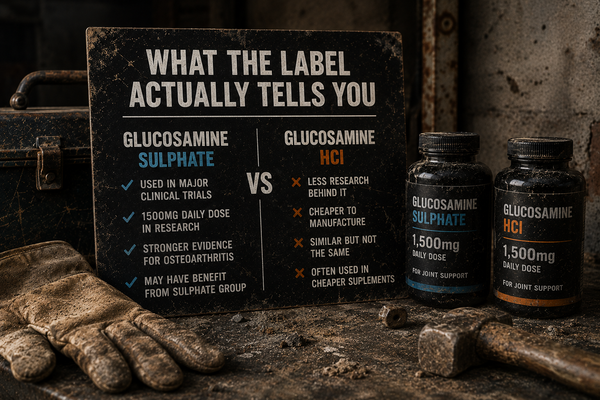
Check the dose of each active ingredient against what the research says works. For glucosamine that's 1,500mg. For chondroitin it's 1,200mg. For MSM it's 1,500-3,000mg. For collagen it depends on type — 40mg for UC-II, 10-15g for hydrolysed. For curcumin it's 500-2,000mg with piperine.
If the label doesn't tell you the individual doses clearly, assume they're too low.
If it lists turmeric without specifying curcumin content or piperine, assume it's decoration.
If it uses proprietary blends, walk away.
If the front of the packet shouts about fifteen ingredients and the back shows tiny doses of each, it's marketing.
If it costs three quid for a month's supply, it's probably useless. If it costs forty quid, check whether that's because the doses are right or because the marketing budget was high.
And if it includes vitamin C alongside collagen, that's a tell that someone on the formulation team actually read the research rather than just copying a competitor's label.
You don't need a PhD to evaluate this stuff. You just need to know what questions to ask. Dose, form, bioavailability. Everything else is noise.
Frequently Asked Questions
Do I need all three ingredients or can I just take one for joint pain?
You don't need all three. Glucosamine and chondroitin remain the baseline with the strongest overall evidence. MSM adds anti-inflammatory benefit if dosed at 1,500-3,000mg daily. Curcumin works if it's paired with piperine and dosed at 500-2,000mg. Start with one or two properly dosed ingredients rather than a formula with trace amounts of everything.
How long before I notice if collagen or MSM is actually working?
Most joint supplement trials measure outcomes at 8-12 weeks minimum. Some people report noticing less stiffness around the 4-6 week mark, but cartilage and connective tissue repair slowly. If you're trialling an ingredient, give it at least two months at the correct dose before deciding it's done nothing.
Is turmeric powder from the spice aisle as good as a supplement?
No. Turmeric root powder contains only 2-5% curcumin, and without piperine the absorption is terrible. A teaspoon of turmeric powder gives you roughly 100mg curcumin at best, poorly absorbed. The effective dose from trials is 500-2,000mg curcumin with piperine. Cooking with turmeric is fine for flavour, useless for joint pain.
Why do some joint supplements cost forty quid and others cost a fiver?
Sometimes you're paying for correct doses of quality ingredients. Often you're paying for marketing, packaging, and celebrity endorsements. Check the actual milligram amounts of active ingredients against research-backed doses. If a cheap product hits those numbers, the expensive one isn't magically better. If neither hits those numbers, both are a waste.
Can I take MSM or curcumin if I'm already on ibuprofen or other painkillers?
MSM has a good safety profile and few reported interactions. Curcumin can have mild blood-thinning effects, so if you're on warfarin or similar medications, check with your GP first. For standard over-the-counter painkillers like ibuprofen or paracetamol, there's no known major interaction, but don't assume supplements replace medical advice if you've got serious joint damage.