What Chondroitin Actually Does (And Why It Matters Alongside Glucosamine)

Most joint supplements list glucosamine and chondroitin together like they're a legally married couple. You see both names on the label, assume they do roughly the same thing, and never think about it again. The truth is they work in completely different ways — and understanding what chondroitin actually does explains why the combination consistently outperforms either ingredient alone.
Why No One Knows What Chondroitin Does
Glucosamine gets all the attention because it's easier to explain. It's a building block. Your body uses it to make cartilage. Simple story.
Chondroitin sounds like something a GP mutters before sending you for an X-ray. Most tradesmen taking it couldn't tell you what it does beyond "something with joints." That's not stupidity — it's because no one bothers explaining it properly.
Here's what it actually is: chondroitin sulphate is a glycosaminoglycan, which is a structural component of cartilage tissue. In plain English, it's part of the matrix that holds cartilage together. Not a building block like glucosamine — more like the framework that keeps everything in place and functioning.
The comparison I've used before: glucosamine is the bricks, chondroitin is the mortar and the steel reinforcement. You need both to build something that lasts under load.
What Chondroitin Actually Does in Your Joints
Chondroitin has three main jobs, all of which matter when you're putting real weight through your knees, hips, wrists, and shoulders daily.
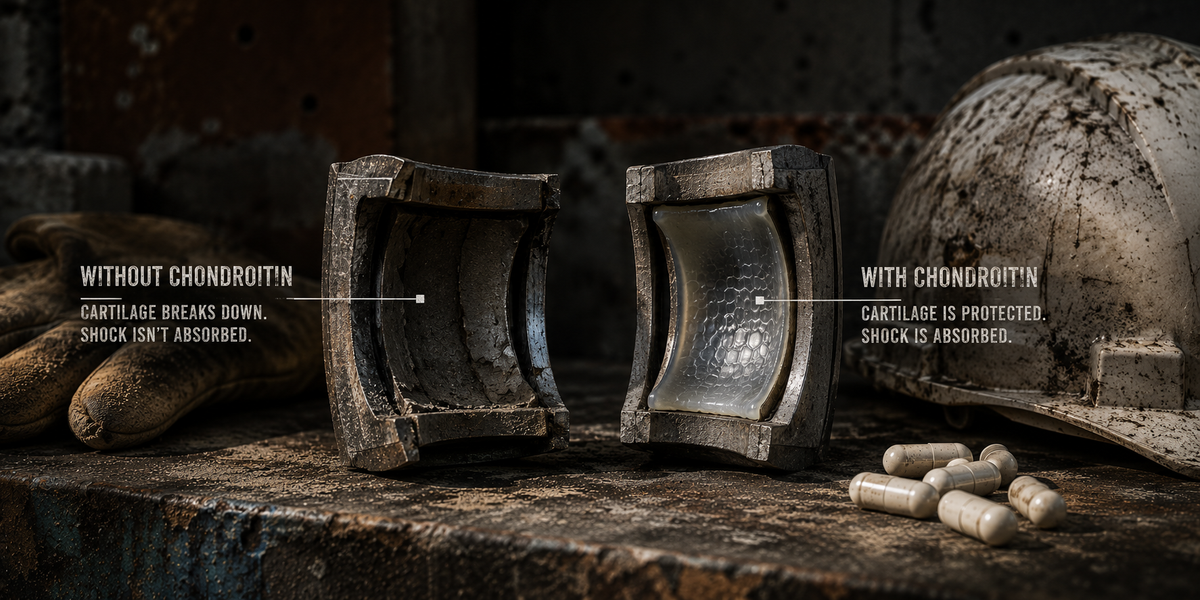
First: it acts as a shock absorber. Chondroitin draws water into the cartilage matrix, which gives cartilage its cushioning properties. When you kneel down on concrete or land hard off a ladder, that water-saturated cartilage is what stops bone grinding directly on bone. Without adequate chondroitin, cartilage loses water content, compresses more easily, and stops doing its job properly.
Second: it inhibits the enzymes that break down cartilage. Specifically, it blocks matrix metalloproteinases — the enzymes your body produces that degrade cartilage tissue. Every time you load a joint under stress, you're creating micro-damage. Your body responds by releasing these enzymes to clear away damaged tissue. Problem is, in inflamed or overloaded joints, those enzymes can start breaking down healthy cartilage as well. Chondroitin helps regulate that process.
Third: it has direct anti-inflammatory properties. It reduces the cytokines associated with cartilage degradation — the inflammatory signals that tell your body to keep attacking the joint. This isn't paracetamol-style pain relief. It's addressing the underlying inflammatory response that accelerates cartilage loss.
All three mechanisms matter when you're doing trade work. You're not just dealing with normal ageing — you're dealing with repetitive load, impact, awkward positions, and inflammation from overuse. Chondroitin addresses the problem from a different angle than glucosamine.
Why the Combination Works Better Than Either Alone
There was a bloke called Gary I worked with laying paving slabs around Nottingham in 2011. Big unit, mid-40s, been doing groundwork since he was 17. His knees were fucked — you could hear them creak when he crouched down to check a level. He'd tried glucosamine on its own for months, said it did fuck all. Then someone told him to add chondroitin. Three months later he told me, sat in the van at lunch, "I don't know if it's in my head, but I'm not waking up stiff anymore. Still hurts when I kneel, but the mornings are better." He kept taking it until he moved into site management a couple of years later. Never found out if it was actually the chondroitin or just time, but he was convinced.
The research backs up why the combination might work when either ingredient alone doesn't. The GAIT trial — the big NIH-funded study everyone references — found that glucosamine and chondroitin together showed a 79.2% response rate in people with moderate-to-severe osteoarthritis, compared to 54.3% for placebo. Glucosamine alone didn't reach statistical significance in the full sample. Chondroitin alone wasn't tested separately in that study, but other trials suggest it performs similarly to glucosamine on its own — moderate benefit, not dramatic.
The combination outperforms because they're addressing the problem from two directions. Glucosamine provides raw material for cartilage synthesis. Chondroitin maintains the structural integrity of existing cartilage and reduces the inflammatory breakdown. You're not just trying to build new tissue — you're protecting what's already there while you do it.
That matters in practice because cartilage regeneration is slow. Your body can't repair cartilage damage overnight like it can repair muscle tissue. The process takes weeks and months. If you're only supplementing the building blocks without protecting against degradation, you're fighting a losing battle. The inflammation and enzymatic breakdown will outpace the repair.
Dosing and Quality (Because Most of It Is Shit)
Research doses for chondroitin sit between 800mg and 1200mg per day, with studies showing benefit consistently using 1200mg. That's not a marketing number — it's what the actual clinical trials dosed at.
The problem is the supplement market is full of products using 400mg or 600mg of chondroitin, paired with 1500mg of glucosamine, because chondroitin costs more and they're trying to keep the price down. You're getting a subtherapeutic dose and wondering why it doesn't work.
Source material matters as well. Most chondroitin comes from bovine cartilage — cow trachea, typically. Some studies used shark cartilage. The bioavailability varies depending on molecular weight and processing. Cheap chondroitin often uses poorly processed material with low absorption rates. You're pissing most of it out rather than absorbing it into tissue.
There's no easy way to verify quality as a consumer. Third-party testing exists but most brands don't bother. The practical filter: if a glucosamine-chondroitin supplement costs less than fifteen quid for a month's supply, it's probably using bargain-bin ingredients at underdosed levels.
How Long It Actually Takes to Work
Chondroitin has a longer half-life than glucosamine. It builds up in tissue over time rather than clearing quickly. That's why the studies showing benefit run for 8-12 weeks minimum. You won't feel anything in the first two weeks. Probably won't feel much in the first month. The effect becomes apparent somewhere between week 6 and week 10 for most people.
That time lag is why so many tradesmen give up on joint supplements. You take them for three weeks, feel nothing, assume they're bollocks, and bin them. Meanwhile the mechanism hasn't even started yet.
The expectation needs adjusting. This isn't ibuprofen. You're not masking pain — you're trying to change the underlying tissue environment so the joint degrades more slowly and repairs more effectively. That process is measured in months, not days.
If you're going to trial glucosamine and chondroitin properly, commit to three months. Take the research dose daily. If you're not seeing any difference in joint stiffness, pain on load, or recovery between sessions by month three, fair assessment that it's not working for you. But two weeks isn't a trial — it's nothing.
The Honesty Bit: What the Research Actually Shows
Meta-analyses on glucosamine and chondroitin are mixed. Some show a statistically significant effect, some don't. That's not because the studies are rigged or the supplements are snake oil — it's because patient populations matter.
The GAIT trial found the combination worked significantly better than placebo in people with moderate-to-severe osteoarthritis. It didn't show the same effect in people with mild OA. That pattern repeats across multiple studies. If your cartilage is already severely degraded and you're dealing with bone-on-bone contact, glucosamine and chondroitin aren't going to reverse structural damage. If you're in the earlier stages — chronic inflammation, cartilage thinning, regular pain but not constant — the evidence is stronger.
The prevention question is harder. There's less data on whether supplementing before significant damage occurs actually prevents that damage long-term. The mechanism suggests it should — maintaining cartilage hydration and blocking degradation enzymes ought to slow wear — but long-term prevention trials are difficult and expensive to run. Most research focuses on treatment rather than prevention because that's where the immediate clinical need sits.
The pragmatic read: if you're already dealing with joint pain from years of trade work, the combination of glucosamine and chondroitin at research doses is worth trying for three months. The evidence supports it more strongly than it supports either ingredient alone. If you're younger and trying to prevent damage before it starts, the data is thinner, but the mechanism is sound and the downside risk is low.
Why This Matters for Tradesmen Specifically
Office workers get osteoarthritis from ageing. Tradesmen get it from ageing plus thirty years of repetitive load and impact. Your knees aren't just wearing out from time — they're wearing out from kneeling on concrete, climbing ladders, carrying weight, and moving in awkward positions daily.
That difference matters because the inflammatory component is higher in trade-related joint damage. You're not just dealing with passive cartilage thinning — you're dealing with active inflammation from repeated microtrauma. Chondroitin's anti-inflammatory and anti-degradation properties are directly relevant to that kind of damage.
The other difference: tradesmen can't just stop using the joint while it heals. Office worker with a dodgy knee can take the lift instead of the stairs for a few weeks. You're still crawling around fixing skirting or laying floors regardless of whether your knees hurt. The joint is under constant load. Protecting existing cartilage while it's still being stressed is the only realistic strategy.
Glucosamine and chondroitin together won't unfuck a joint that's already gone. But if you're in the stage where it hurts regularly but you can still work, and you're trying to stretch out how many years you've got left before the pain forces you into different work, the combination is one of the few interventions with decent evidence behind it.
Chondroitin isn't magic. It's a structural component of cartilage that you can supplement to maintain tissue integrity under load. The combination with glucosamine works better than either alone because they address different parts of the problem. If you're going to bother taking a joint supplement, make sure it's dosed properly and give it the three months it needs to show whether it works for you.
Frequently Asked Questions
How long does it take for chondroitin to start working for joint pain?
Chondroitin builds up in joint tissue over 6-10 weeks, so you won't feel any difference in the first month. Clinical trials consistently show benefits appearing between weeks 8 and 12, not days or weeks. If you're expecting ibuprofen-style quick relief, you'll be disappointed — this is about changing the underlying cartilage environment, which takes months.
What's the difference between glucosamine and chondroitin for joints?
Glucosamine provides raw building blocks for new cartilage synthesis, while chondroitin protects existing cartilage by drawing water into the tissue and blocking the enzymes that break it down. Think of glucosamine as supplying bricks and chondroitin as the mortar holding everything together — you need both for joints under constant load from trade work.
How much chondroitin should I take daily for my knees?
Research doses that show actual benefit use 1200mg of chondroitin per day, typically split into two doses or taken once daily. Many cheap supplements only contain 400-600mg, which is below the therapeutic threshold used in clinical trials. Check your label — if it's under 800mg daily, you're likely wasting your money.
Does chondroitin work better with glucosamine or on its own?
The combination consistently outperforms either ingredient alone in studies. The GAIT trial found a 79.2% response rate for the combination versus 54.3% for placebo in people with moderate-to-severe osteoarthritis, while glucosamine alone didn't reach statistical significance. They work through different mechanisms, so taking both addresses cartilage damage from two directions simultaneously.
Will chondroitin help prevent joint damage if I don't have pain yet?
The evidence for prevention is thinner than for treatment of existing damage because long-term prevention trials are expensive and rare. The mechanism suggests it should help — maintaining cartilage hydration and blocking degradation enzymes ought to slow wear — but if your joints are currently fine, the data supporting preventive use isn't as strong as it is for people already dealing with pain.