How Long Does Glucosamine Actually Take to Work? (And Why Most People Give Up Too Soon)

How Long Does Glucosamine Actually Take to Work? (And Why Most People Give Up Too Soon)
The reason most people think glucosamine doesn't work is the same reason the research says it does — it's slow.
You bought a bottle. Took it for three weeks. Felt nothing. Decided it was bollocks and went back to just dealing with the stiffness. Fair enough — except the clinical trials that showed benefit didn't measure anything until week 12. You evaluated at week 3. You stopped before it had time to do what it's supposed to do.
This isn't a defence of glucosamine as some miracle supplement. It's not. About 40-50% of people who take it see meaningful benefit. The rest don't. But the lads who dismiss it after a fortnight aren't in either category yet — they're just impatient with a supplement that works on cartilage biology timescales, not painkiller timescales.
If you're going to spend money on joint support, you should at least know how long a fair trial actually looks.
The Timeline No One Tells You About
The major clinical trials — GAIT, GUIDE, the European studies — ran for 12 to 24 weeks minimum. Some continued for years. That's not because researchers were arsing about. It's because that's how long it takes for cartilage to respond to increased substrate availability.
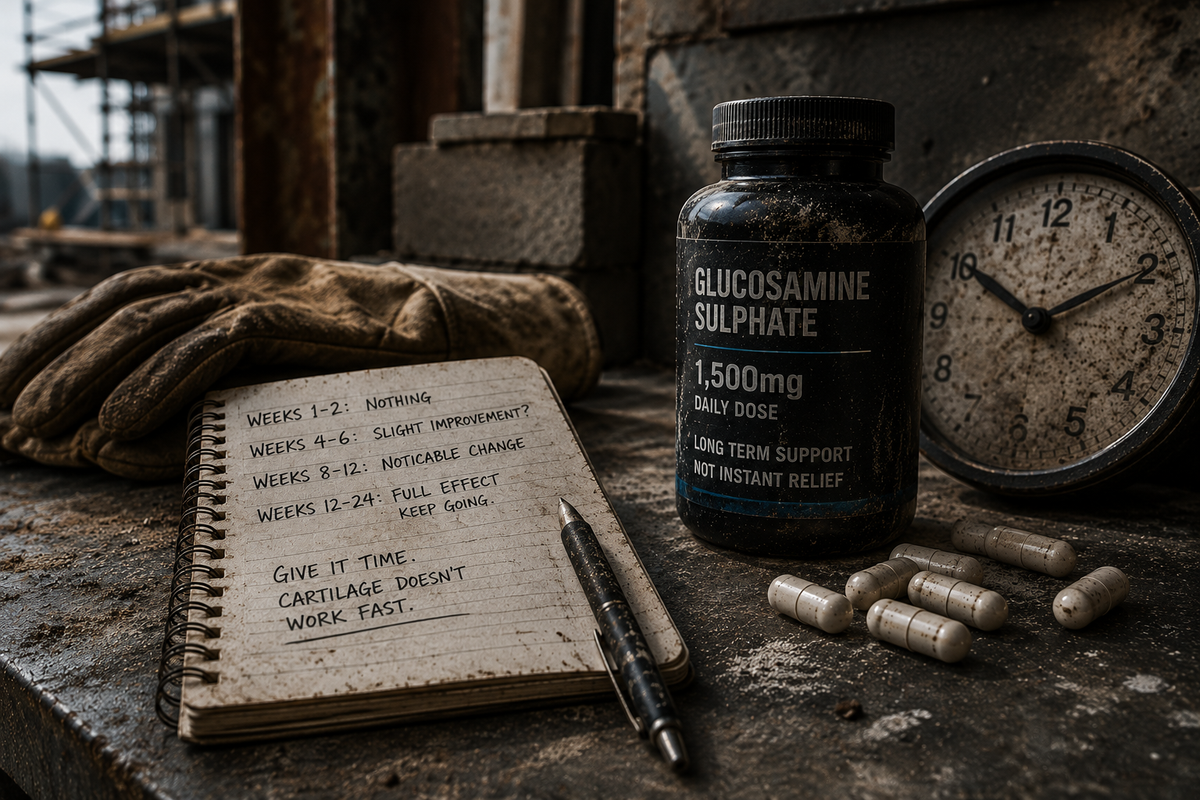
Weeks 1-2: Nothing. You're building up tissue levels. Glucosamine is getting into synovial fluid, starting to become available to chondrocytes (the cells that maintain cartilage). You won't notice a thing. If you're expecting to feel different at this point, you've misunderstood what glucosamine is.
Weeks 4-6: Some people — not most — start noticing mild improvement. Slightly less morning stiffness. Marginally easier to get moving after sitting in the van for an hour. If you notice something here, good. If you don't, that's also normal.
Weeks 8-12: This is when the studies start showing statistically significant benefit in the groups that respond. Reduced pain scores. Improved joint function measurements. Better mobility markers. This is the minimum evaluation window. Anything before week 8 is premature.
Weeks 12-24: Full effect for most responders. The GAIT trial ran 24 weeks. GUIDE ran 6 months. Some studies show continued improvement beyond that with ongoing use. The benefit plateaus but doesn't reverse while you're still taking it.
After stopping: Effects fade over weeks to months. Cartilage turnover is slow in both directions. You don't lose the benefit overnight, but you don't keep it indefinitely either.
Most people try a supplement for about the length of time it takes to finish a small bottle — maybe a month. Then they judge it. That's like planting a tree, checking after two weeks, seeing no apples, and concluding the tree's dead.
Why It Takes This Long (And Why Painkillers Don't)
Glucosamine isn't a painkiller. It doesn't block inflammation. It doesn't dull nerve signals. It doesn't do anything you'd feel in the short term. What it does — in theory, in the people who respond — is provide building blocks for glycosaminoglycans, which are structural components of cartilage.
Cartilage has no blood supply. None. It gets nutrients through compression and decompression — literally through movement — and from synovial fluid. That's it. So getting glucosamine from your stomach, into your bloodstream, into synovial fluid, and then into cartilage tissue is a slow process compared to, say, ibuprofen hitting prostaglandin receptors in your bloodstream within 30 minutes.
The tissue response is gradual. Cartilage doesn't regenerate quickly under any circumstances. You're not growing new cartilage — you're (possibly) slowing the rate of breakdown and supporting the maintenance of what's there. Chondroitin, which is often combined with glucosamine, has an even longer half-life. It builds up over weeks.
Comparing glucosamine to ibuprofen is a category error. One treats pain today by blocking inflammatory pathways. The other potentially reduces structural deterioration over months by supporting cartilage metabolism. Different mechanisms. Different timescales. Different goals.
If you want immediate relief, take a painkiller. If you want to potentially reduce long-term joint degradation, glucosamine might help — but only if you're willing to give it the time the biology requires.
What the Studies Actually Show (And Don't Show)
The big trials are mixed, which is why you get contradictory information depending on who's selling what.
GAIT (Glucosamine/Chondroitin Arthritis Intervention Trial) ran for 24 weeks on over 1,500 people with knee osteoarthritis. The overall result was: no statistically significant benefit for the full group. But the subset with moderate-to-severe OA did show significant improvement. Mild OA didn't respond much. The people with proper cartilage damage saw more benefit than the people with early wear.
GUIDE (Glucosamine Unum In Die Efficacy) ran for 6 months. Showed consistent benefit for pain and function. European studies tend to show more positive results than American ones, possibly due to different glucosamine formulations (crystalline vs sulfate salt forms).
The pattern across studies: about 40-50% of people respond. Those with moderate damage respond better than those with mild damage. Those who give it 12-24 weeks see more benefit than those who quit early. And none of the studies showing benefit measured anything meaningful before 8 weeks.
There was a tiler I worked with in Sheffield, must have been around 2016. Bloke called Andy, mid-40s, knees already gone from decades on hard floors. He tried glucosamine twice. First time, took it for three weeks, felt nothing, binned it. Told everyone it was a waste of money. Second time, a physio told him the same thing I'm telling you now — 12 weeks minimum. He kept a little notebook, rated his knee pain every Monday morning on a 1-10 scale. Week 4, no change. Week 8, maybe a point lower but he wasn't sure. Week 14, consistently two points lower than where he started, and he could kneel for longer without the sharp pain. He said to me, "I wrote the date I started on the bottle. Made myself finish it before deciding. If I'd stopped when I felt like stopping, I'd still think it was bollocks."
He's still taking it now, as far as I know. Works for him. Doesn't work for everyone. But he wouldn't have found out either way if he'd quit at week 3.
Setting Realistic Expectations
Glucosamine is not going to reverse severe cartilage loss. It's not going to fix bone-on-bone arthritis. It's not going to make a 50-year-old's knees feel like they did at 25. Anyone telling you otherwise is selling you something dishonestly.
What it might do, in the people who respond, is slow the rate of cartilage degradation. Reduce pain and stiffness modestly. Improve function enough that you notice it in daily tasks — getting out of the van, kneeling, squatting, climbing ladders. The research suggests it's most effective as maintenance for people with moderate damage, not as rescue therapy for people with severe damage.
Age matters. The earlier you start taking it, the more you have to preserve. Starting glucosamine at 35 when your knees just started feeling a bit off is a different proposition than starting at 55 when you've got established osteoarthritis. Prevention is easier than restoration. Cartilage that's already significantly degraded is harder to support than cartilage that's just beginning to wear.
Consistency matters. Taking it sporadically won't work. The tissue levels need to stay elevated. Missing days here and there undermines the whole point. It's not like a painkiller where you take it when you need it — it's a daily maintenance compound.
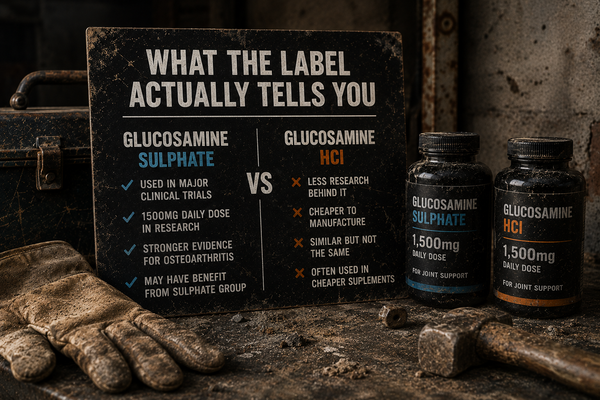
Dosage and form matter. Most studies used 1,500mg of glucosamine sulfate daily. Some used glucosamine hydrochloride. The sulfate form tends to show better results in European studies. Under-dosing because you're trying to make a cheap bottle last longer defeats the purpose.
How to Actually Evaluate Whether It's Working
The problem with gradual improvement is that you don't notice it day-to-day. You adjust. Your baseline shifts without you realising. That's why keeping some kind of log matters.
Doesn't have to be elaborate. A simple note in your phone once a week: pain level 1-10, how long you can kneel before it hurts, how stiff you feel first thing in the morning, whether you're taking ibuprofen as often. Something you can look back at after 12 weeks and actually compare.
Without that, you're relying on memory and vague feelings, which are unreliable for detecting small incremental changes over months. You remember the bad days more than the average days. You forget what your knees felt like three months ago unless you wrote it down.
Minimum fair trial: 12 weeks. Consistent daily dosing at the clinically-studied amount (1,500mg glucosamine, 1,200mg chondroitin if you're taking that as well). Tracking something measurable, even if it's just a weekly pain rating.
If you get to 16-20 weeks on correct dose, consistent use, proper form, and you've tracked it honestly — and there's nothing — then it's fair to conclude it's not working for you. You're in the 50-60% who don't respond, or your joint damage is beyond what substrate supplementation can help with. Stop taking it. Spend the money elsewhere.
But don't bin it at week 3 and claim you gave it a fair go. You didn't. You gave up before the mechanism had time to work.
The Honest Version
Most supplement marketing is dishonest about timelines because honesty doesn't sell. "Take this for four months and maybe notice a modest improvement" doesn't shift units like "Feel the difference in days!" does. So people buy things with unrealistic expectations, don't see miracles, and conclude the whole category is a con.
Glucosamine isn't a miracle. It's a structural support compound with a slow mechanism and a subset response rate. For the people it works for, it's genuinely useful. For the people it doesn't work for, no amount of time will change that. But you won't know which group you're in unless you give it the timeline the biology requires.
If your knees hurt every morning, if you're stiff getting out of the van, if you're 35-50 and you can already feel the damage accumulating — glucosamine is worth 12 weeks of your time. It's not expensive. It's well-tolerated. The downside of trying it properly is minimal. The downside of not trying it, if you're in the group it would've helped, is years of preventable deterioration.
Just don't expect it to work like a painkiller. It's not trying to. It's playing a longer game than that.
Frequently Asked Questions
How long before I know if glucosamine is working for my joints?
You need a minimum of 12 weeks at the correct dose (1,500mg daily) to evaluate properly. Most clinical trials showing benefit didn't measure results before 8-12 weeks because cartilage tissue responds slowly. If you notice nothing by week 16-20 with consistent use, it's fair to conclude you're in the 50-60% who don't respond and stop taking it.
Can I take glucosamine with ibuprofen or other painkillers?
Yes, glucosamine works through a completely different mechanism than NSAIDs like ibuprofen. Glucosamine provides structural support for cartilage over months while painkillers block inflammatory pathways for immediate relief. Many people use both — painkillers for acute flare-ups and glucosamine as long-term maintenance. There are no known interactions between the two.
Why does glucosamine work for some people but not others?
Research shows roughly 40-50% of people respond to glucosamine supplementation, with better results in those who have moderate joint damage rather than mild or severe deterioration. Your individual cartilage biology, the extent of existing damage, genetic factors affecting cartilage metabolism, and whether you're taking the right form and dose all influence response. There's no reliable way to predict who will respond before trying it.
Should I take glucosamine sulfate or glucosamine hydrochloride?
Most positive clinical studies used glucosamine sulfate at 1,500mg daily, and European research tends to show better results with the sulfate form. Glucosamine hydrochloride is also studied but has less consistent evidence. The sulfate form appears more effective for joint support, though both are well-tolerated. Avoid products that don't clearly state the form or provide inadequate dosing.
Is it too late to start taking glucosamine if I already have arthritis?
Glucosamine works best as maintenance for moderate joint damage, not as rescue therapy for severe bone-on-bone arthritis. If you're 35-50 with early-to-moderate wear, starting now gives you more cartilage to preserve. Starting at 55 with established osteoarthritis can still provide modest benefit for the 40-50% who respond, but expectations should be realistic — you're supporting what remains, not reversing significant damage.