Glucosamine Sulphate vs Glucosamine HCl — What the Label Actually Tells You

Most blokes over 40 have bought glucosamine at some point. Boots, Holland & Barrett, Amazon, wherever — you've seen the word "glucosamine" on the tub and thought that's job done. Turns out there are two different forms of the stuff, and they're not the same thing. Most of the clinical trials that showed glucosamine actually working used glucosamine sulphate. Most cheap supplements use glucosamine HCl. The two are not interchangeable, but the labels don't make that obvious.
This isn't splitting hairs. If you're spending money on something to protect your joints, you might as well know what you're actually buying.
The Two Forms — And Why Most People Don't Know There's a Difference
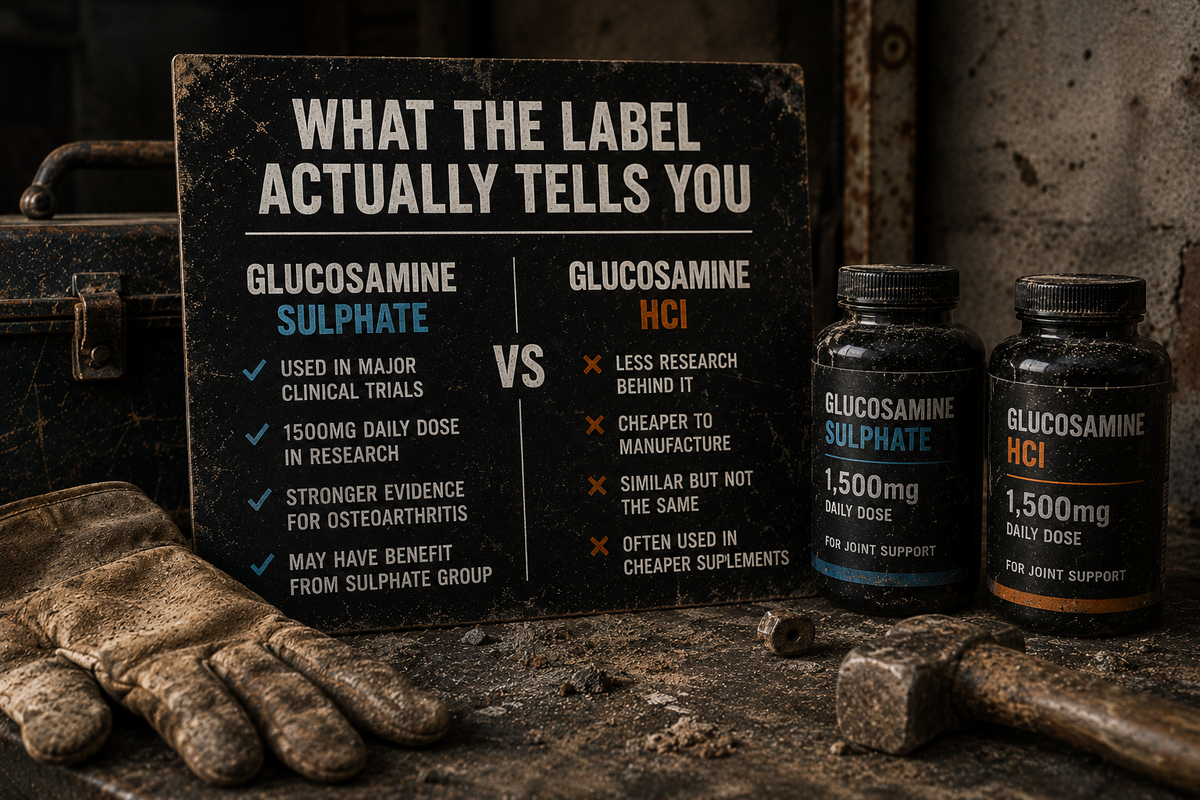
Glucosamine comes in two main forms: glucosamine sulphate and glucosamine hydrochloride (HCl). Chemically, they're both delivering glucosamine — the molecule your cartilage uses for repair — but they're bound to different compounds. Sulphate form has a sulphate group attached. HCl form has that removed and replaced with a hydrochloride stabiliser.
Most people assume the word "glucosamine" on the label means the same thing regardless. It doesn't. The form matters because most of the research showing benefit used sulphate, not HCl.
The GAIT trial (Glucosamine/Chondroitin Arthritis Intervention Trial), the GUIDE trial, the MOVES trial — the big clinical studies that tested whether glucosamine actually does anything for osteoarthritis — used glucosamine sulphate. The Cochrane Review found that glucosamine sulphate specifically showed benefit in some osteoarthritis studies. Glucosamine HCl showed less consistent results.
That doesn't mean HCl definitely doesn't work. It means we have less evidence that it does.
Why HCl Is Everywhere — And It's Not Because It's Better
If sulphate has better evidence, why is HCl so common in cheap supplements? Two reasons.
First: it's cheaper to manufacture. Glucosamine HCl is a simpler compound to produce and stabilise. Lower production cost means higher margin for the supplement company. That's it. No mystery.
Second: it contains more pure glucosamine by weight — glucosamine HCl is about 83% glucosamine by weight while glucosamine sulphate is about 65%. So a company can put 1000mg of HCl on the label and claim it delivers more actual glucosamine than 1000mg of sulphate. Sounds better. Technically true. But it misses the point.
The sulphate component might matter. Sulphate is used by cartilage to synthesise glycosaminoglycans — the compounds that give cartilage its structure and shock absorption. Some researchers think the sulphate group in glucosamine sulphate isn't just a carrier; it's contributing to the effect. Others argue the glucosamine molecule is what matters and the sulphate is irrelevant because your body gets sulphate from diet anyway.
The science is genuinely uncertain on this. But here's what isn't uncertain: the trials that showed benefit used sulphate, not HCl. If you're putting money down, that's the form with the track record.
The Dose Comparison Problem — 1500mg Isn't Always 1500mg
This is where label reading gets annoying. A product that says "1500mg glucosamine" might mean 1500mg of glucosamine sulphate, or it might mean 1500mg of glucosamine HCl, or it might mean 1500mg of "elemental glucosamine" calculated from either form. They're not equivalent.
Because HCl is 83% glucosamine and sulphate is 65%, the same milligram amount delivers different amounts of the actual molecule. Some companies list "glucosamine (as glucosamine HCl) 1500mg" and you're meant to work out that the elemental glucosamine is lower. Some just say "glucosamine 1500mg" and don't tell you the form at all.
If the label doesn't specify sulphate or HCl, that's a red flag. It usually means HCl, because sulphate costs more and companies using it tend to say so.
The dose that most positive trials used was 1500mg per day of glucosamine sulphate — not elemental glucosamine, but the full sulphate compound. If you're comparing products, check whether the dose listed is the sulphate compound weight or the calculated elemental glucosamine. They're different numbers.
What Europe Does Differently — And Why That Matters
In several European countries, glucosamine sulphate is available as a prescription product, not just a supplement. The prescription form is crystalline glucosamine sulphate — a patented stabilised version that was used in most of the positive clinical trials. It's prescribed for osteoarthritis under brand names like Dolenio and Glusartel.
That tells you something. European drug regulators, who are generally more cautious than supplement regulators, approved glucosamine sulphate as a pharmaceutical treatment based on clinical evidence. They did not approve glucosamine HCl. The distinction was meaningful enough to matter in a regulatory decision.
The supplement market, by contrast, treats the two forms as interchangeable because there's no legal requirement to differentiate them. Both can be sold as "glucosamine." Both can make structure-function claims about joint health. The evidence base behind them is not the same, but the label rules don't require companies to explain that.
The Counterargument — Some Researchers Think the Form Doesn't Matter
Not everyone agrees the sulphate vs HCl distinction is significant. Some studies have shown benefit with HCl. Some researchers argue that once glucosamine is absorbed, the sulphate group is cleaved off anyway, so the carrier form is irrelevant.
There's also the complication that glucosamine sulphate usually contains sodium or potassium chloride as a stabiliser, which means the comparison isn't just sulphate vs HCl — it's sulphate plus stabiliser vs HCl. Teasing apart which component does what is difficult.
The Cochrane Review acknowledged this uncertainty. The review found that pooled data on glucosamine in general showed inconsistent results, but when they looked specifically at the crystalline sulphate form used in prescription products, the results were more consistent. That doesn't prove HCl doesn't work. It proves sulphate has better evidence.
If the science were settled, this wouldn't be a comparison article. It's not. But when the science is uncertain, you go with the version that has the track record. That's sulphate.
What to Actually Check When You Read a Label
If you've already got a tub of glucosamine in the cupboard, flip it over and look at the ingredients panel. Not the front label — the actual ingredients list. Look for one of these:
- "Glucosamine sulphate" — this is what you want.
- "Glucosamine hydrochloride" or "glucosamine HCl" — this is the cheaper form with less evidence.
- Just "glucosamine" with no form specified — assume HCl.
Check the dose. If it says 1500mg glucosamine sulphate, that's the standard daily dose used in most trials. If it says 1500mg glucosamine HCl, that's delivering less actual glucosamine than 1500mg sulphate, but more importantly, it's not the form most trials tested.
Some products combine both forms, or add chondroitin, or mix in MSM or other joint ingredients. That's fine, but it makes comparison harder. If you're just comparing glucosamine products, the form and dose are the two things that matter.
A tiler I worked with in Leeds around 2016 told me he'd been taking glucosamine for his knees for about five years. Must have been mid-forties. I asked him which type. He didn't know there were types. Turned out he'd been buying whatever was cheapest at Tesco — glucosamine HCl, 1000mg, because it was on offer. He'd never noticed any difference. I'm not saying sulphate would have fixed his knees, but he'd been spending money for five years on a version with weaker evidence at a dose below what the trials used. When he switched to 1500mg sulphate, he said it felt different within a few weeks. Could have been placebo. Could have been the dose. Could have been the form. Either way, he'd wasted five years on something that clearly wasn't doing the job.
The Honest Answer — This Isn't Settled Science
If you're waiting for a definitive answer on whether sulphate is objectively better than HCl, you'll be waiting a while. The research is inconsistent. Some studies show benefit with sulphate. Some show benefit with HCl. Some show neither works beyond placebo. Joint supplements in general sit in that awkward zone where the evidence is good enough to keep taking them, but not strong enough to make everyone a believer.
What we can say: most of the trials that showed glucosamine working for osteoarthritis used glucosamine sulphate, specifically the crystalline form that's available on prescription in Europe. If you're choosing between two products and one uses sulphate and one uses HCl, sulphate has the better track record. That doesn't make it a miracle cure. It makes it the more evidence-backed option.
If you've been taking HCl and it's working for you, keep taking it. If you've been taking something labelled "glucosamine" with no form specified and you've noticed no benefit, try switching to a sulphate product at 1500mg daily and give it three months. That's the version with the evidence.
The supplement industry doesn't make this easy. Forms, doses, stabilisers, combined ingredients — it's all designed to look the same on the shelf while costing different amounts to produce. If you're going to put money into something for your joints, you might as well know what the label actually means. Sulphate has the track record. HCl is cheaper. That's the trade-off.
Frequently Asked Questions
What's the difference between glucosamine sulphate and glucosamine HCl?
Glucosamine sulphate has a sulphate group attached to the glucosamine molecule, while glucosamine HCl uses a hydrochloride stabiliser instead. Most clinical trials showing benefit for osteoarthritis used the sulphate form, not HCl. Glucosamine HCl is cheaper to manufacture and contains more pure glucosamine by weight (83% vs 65%), but it has less research evidence supporting its effectiveness.
Which form of glucosamine is better for joint pain?
Glucosamine sulphate has stronger clinical evidence, particularly the crystalline form used in European prescription products. The major trials (GAIT, GUIDE, MOVES) and Cochrane Reviews showing benefit for osteoarthritis primarily tested glucosamine sulphate at 1500mg daily. If you're choosing between products, sulphate is the evidence-backed option, though some people report benefit from HCl as well.
How do I know which type of glucosamine is in my supplement?
Check the ingredients panel on the back of the bottle, not the front label. It should specifically say "glucosamine sulphate" or "glucosamine hydrochloride (HCl)". If it just says "glucosamine" without specifying the form, it's usually the cheaper HCl version. Companies using sulphate typically state it clearly because it costs more to produce.
Is 1500mg of glucosamine HCl the same as 1500mg of glucosamine sulphate?
No. While both deliver glucosamine, HCl contains 83% pure glucosamine by weight and sulphate contains 65%, so 1500mg of each provides different amounts of the actual molecule. More importantly, the clinical trials that established the 1500mg daily dose used glucosamine sulphate compound weight, not elemental glucosamine calculations. The form tested matters as much as the dose.
Why is glucosamine sulphate prescription-only in some European countries but not in the UK?
Several European drug regulators approved crystalline glucosamine sulphate as a pharmaceutical treatment for osteoarthritis based on clinical trial evidence. They did not approve glucosamine HCl for the same purpose. In the UK and US, both forms are sold as supplements without prescription, and regulations don't require companies to explain the evidence difference between the two forms.