Why Most Joint Supplements Use the Wrong Dose


You bought a joint supplement once. Probably from Boots or Holland & Barrett, maybe a supermarket own-brand. Took it for six weeks, noticed nothing, decided glucosamine was bollocks and went back to just getting on with it. Fair enough — except the reason it didn't work might not be what you think.
The clinical trials that showed glucosamine could help with joint pain used 1,500mg per day. The product you bought probably had 500mg. That's not a minor difference. That's the difference between a tested dose and something a manufacturer can legally put on a label and call "joint support."
You didn't prove glucosamine doesn't work. You proved that taking a third of the effective dose doesn't work. Which is not the same thing.
What the Research Actually Tested
The big trials — the ones funded by proper research bodies, run by universities, published in medical journals — all used similar doses.
The GAIT trial, funded by the US National Institutes of Health in 2006, tested 1,500mg of glucosamine sulphate per day against placebo and conventional pain medication. Over 1,500 people with knee osteoarthritis, followed for six months. It showed benefit for a subset of participants, particularly those with moderate to severe pain.
The GUIDE trial in Belgium compared 1,500mg glucosamine sulphate daily against paracetamol and placebo. Same story — 1,500mg dose, tested over months, showed measurable effect on pain and function.
The MOVES trial, again knee osteoarthritis, again 1,500mg glucosamine sulphate as the daily dose.
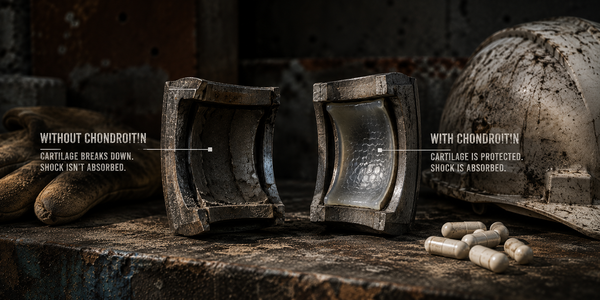
Chondroitin research showing benefit typically used 800-1,200mg per day. Not 200mg. Not 400mg. The high end of what actually got tested in controlled conditions.
These aren't small pilot studies done by supplement companies to justify marketing claims. These are large-scale trials designed to find out whether the stuff actually does anything. And the dose they used was consistent.
Now walk into Boots and pick up a glucosamine product at random. Check the label. You'll probably find 500mg per capsule, sometimes less. The instructions might say "take one daily" or "take two daily." Even at two, you're still only hitting 1,000mg — two-thirds of what the research tested.
The label will still say "supports joint health" or "helps maintain healthy joints." Both statements are legally fine to make. There's no regulated minimum dose required to print those words on a box.
Why Companies Under-Dose
It's cheaper.
Glucosamine costs money to source and manufacture. A product with 500mg per dose costs less to produce than one with 1,500mg. The margin is better. The retail price can be lower, which makes it look like better value on the shelf.
And because most consumers don't know what dose the research used, they can't tell the difference. They see "glucosamine supplement" on two products, one costs a tenner and one costs twenty-five quid, and they buy the tenner one. Makes sense.
Except the tenner one doesn't contain enough of the active ingredient to do what the research showed it could do. So you take it, it doesn't work, and you conclude the whole category is a con.
The supplement industry isn't regulated the way pharmaceuticals are. If a doctor prescribes you 500mg of something, that's because 500mg is the tested therapeutic dose. If it were 1,500mg, the prescription would say 1,500mg. There's no room for a manufacturer to decide "we'll just put less in and charge less."
Supplements don't work that way. A company can put any dose in a capsule as long as the label is accurate about what's inside. "Joint support with glucosamine" is a legal claim at 100mg. It's legal at 1,500mg. The words on the front don't tell you which one you're holding.
I knew a brickie called Alan who worked out of Croydon, mid-2000s, must have been about 48 at the time. His knees were shot — you could hear them click from across the site when he knelt down to lay a course. He'd bought some glucosamine tablets from Tesco, took them religiously for two months, and told me they were "a complete waste of money." I asked him what dose they were. He didn't know. I checked the box in his van at dinner — 500mg glucosamine HCl, one tablet daily. I showed him the back of a tub I'd been using — 1,500mg glucosamine sulphate, three tablets daily. He looked at the label for a long time, then said, "So I've been taking fuck-all, basically." He never bought another supplement after that. Decided the whole thing was a scam. Retired at 52 because he couldn't kneel anymore.
That's what under-dosing does. It doesn't just waste someone's money. It convinces them the solution doesn't exist.
What You're Actually Buying
Let's be specific about what ends up on the shelves.
Own-brand supermarket products: Usually 500-750mg glucosamine per tablet. Often glucosamine hydrochloride rather than sulphate — cheaper to produce, less evidence behind it. Instructions say take one or two daily. Total daily dose: 500-1,500mg, and that's if you remember to take two.
High-street chemist products (Boots, Superdrug, Holland & Barrett standard range): Better, but not by much. Commonly 1,000mg per dose, sometimes split across two tablets. Better than the supermarket stuff, still not hitting the research dose unless you double up.
Premium range products: Some do use 1,500mg. They cost more, obviously, because they contain more. But they also tend to be the ones gathering dust on the shelf because they're next to a product that says the same thing for half the price.
The problem isn't that effective products don't exist. It's that the ineffective ones look identical unless you know what you're checking for.
The Label-Reading Test
Before you buy any joint supplement, check three things:
1. Dose per serving, not dose per tablet
Some products list 500mg on the front in big print, then in smaller print say "per tablet" with instructions to take three tablets daily. The total dose is 1,500mg, but you'd miss it if you only read the front.
Other products put 1,500mg on the front and that's actually the total daily dose across multiple tablets. You need to check the back panel and do the maths.
The question is: if I follow the instructions on this packet, how much am I actually taking per day?
2. Type of glucosamine
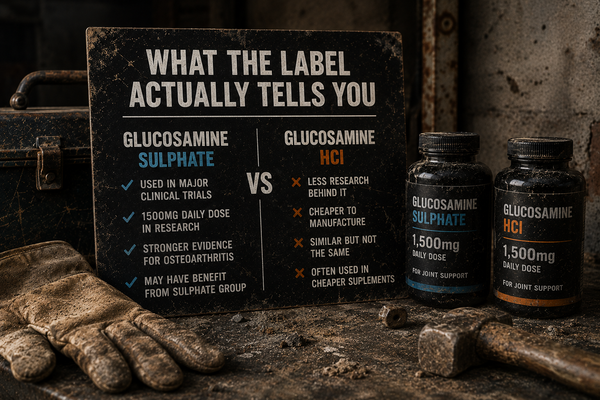
Glucosamine sulphate has more research supporting its effectiveness than glucosamine hydrochloride. It's not that HCl definitely doesn't work — it's that the big trials used sulphate. If you're going off evidence, sulphate is the safer bet.
Some products use a combination. Some use HCl because it's cheaper. The label will specify which one. If it just says "glucosamine" with no type listed, walk away.
3. Dose of other ingredients if it's a combination product
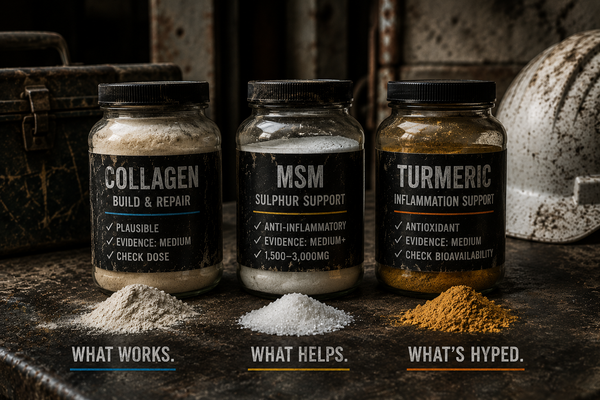
A lot of joint supplements throw in chondroitin, MSM, collagen, turmeric, whatever else. Fine — some of those have evidence too. But check the dose of each.
If a product has glucosamine, chondroitin, MSM, and turmeric all in one tablet, and the total weight of the tablet is 1,000mg, then none of those ingredients can be at an effective dose. You're getting a bit of everything and a meaningful amount of nothing.
Chondroitin research mostly used 800-1,200mg daily, while MSM studies tested 1,500-3,000mg. If the label says 200mg chondroitin and 100mg MSM, it's decorative. It's there so the marketing team can say "contains chondroitin and MSM."
Better to have fewer ingredients at proper doses than a long list at pointless ones.
The Cost Argument
Here's the bit that sounds counterintuitive: the cheaper product often costs you more.
A £10 bottle of 500mg glucosamine tablets lasts a month. You take it for two months, notice nothing, stop. You've spent £20 and got no result.
A £25 bottle of 1,500mg glucosamine lasts a month. You take it for three months, which is roughly how long the research suggests it takes to see benefit if it's going to work for you. You've spent £75.
But if it works, you've spent £75 solving a problem that was costing you hours of discomfort, probably some lost work, definitely some shit sleep. If it doesn't work, you've spent £75 finding out that glucosamine isn't going to help you, which is useful information — you can move on to something else instead of wondering.
The £20 option doesn't give you either outcome. It just wastes time.
This is not an argument to spunk money on expensive supplements for the sake of it. It's an argument to buy the thing that was actually tested, at the dose it was tested at, for long enough to know whether it does anything.
If you're going to try something, try the version that has a chance of working.
What the Research Doesn't Say
Worth being clear: the research on glucosamine is mixed. Not every study shows benefit. Some show it works no better than placebo. Some show it helps a specific subset of people — usually those with moderate to severe joint damage — and does nothing for mild cases.
It is not a miracle cure. It is not going to reverse 20 years of kneeling on concrete. It is not a substitute for actual medical treatment if your joints are fucked.
What the research does say is that for some people, at 1,500mg per day, taken consistently over months, it reduces pain and improves function compared to placebo. Not everyone. Not every joint problem. But some people, measurably, in controlled conditions.
That's a narrow claim. But it's a real one.
The issue is that most people never test that claim properly because they never take the dose that was tested. They take a random amount, decided by a product manager trying to hit a price point, and then conclude the research must be wrong.
The research might be wrong. Or it might be right for some people and you're not one of them. But you won't know unless you actually test what the research tested.
Single Dose vs Split Dose
One last practical detail: most of the trials used a single daily dose of 1,500mg, not split doses throughout the day.
Some products tell you to take 500mg three times a day. That works out to the same total, but it also means you have to remember to take tablets at breakfast, lunch, and dinner. Most people forget the lunchtime one within a week.
If a product gives you the option to take the full dose in one go, that's easier to stick to. Compliance matters more than theoretical absorption benefits.
The Real Question
The real question isn't whether glucosamine works. The real question is: are you taking enough of it to find out?
If you tried it once, years ago, and it did nothing — check what dose you were taking. If it was under 1,500mg daily, you didn't test glucosamine. You tested under-dosed glucosamine, which is not the same thing.
If you're thinking about trying it now, don't buy the cheapest thing on the shelf. Check the label, do the maths, and make sure you're actually taking the amount the research used. Otherwise you're pissing money away on a version of the experiment that was never designed to work.
The supplement industry will keep selling under-dosed products as long as people keep buying them. But you don't have to be one of those people. Read the back of the packet, check the dose, and make sure you're getting what you're paying for.
Frequently Asked Questions
How long does glucosamine take to work if I'm taking the right dose?
Most clinical trials tracked participants for at least 12 weeks before measuring benefits, with some people noticing changes around 6-8 weeks. If you're taking 1,500mg daily of glucosamine sulphate and see nothing after three months, it's probably not going to help your particular joint problem.
Is glucosamine hydrochloride as good as glucosamine sulphate?
The majority of positive research used glucosamine sulphate at 1,500mg daily, so that form has stronger evidence behind it. Glucosamine hydrochloride is cheaper to manufacture but has less clinical data supporting its effectiveness, particularly at the doses commonly found in budget supplements.
Can I just take more tablets of a lower-dose product to reach 1,500mg?
Yes, if the maths works out and you can stick to it. Three 500mg tablets daily equals 1,500mg total. The problem is compliance — most people forget the second or third dose within days, which puts you back at an ineffective amount.
Why do some joint supplements have ten different ingredients at tiny doses?
Marketing. A long ingredient list looks impressive on the label and lets the manufacturer make multiple claims like "with turmeric and collagen." But if each ingredient is under-dosed, you're getting none of them at amounts that clinical research tested.
Will taking more than 1,500mg of glucosamine work better?
The research doesn't support doses higher than 1,500mg daily providing additional benefit. Taking more just costs more and increases the chance of side effects like digestive upset. Stick to the tested dose for at least three months before deciding whether it works for you.