What a 63-Year-Old Bricklayer Wishes He'd Known About His Knees at 25
A working bricklayer shares what decades on the tools taught him about knee pain — and what he'd do differently if he could go back to his 20s.

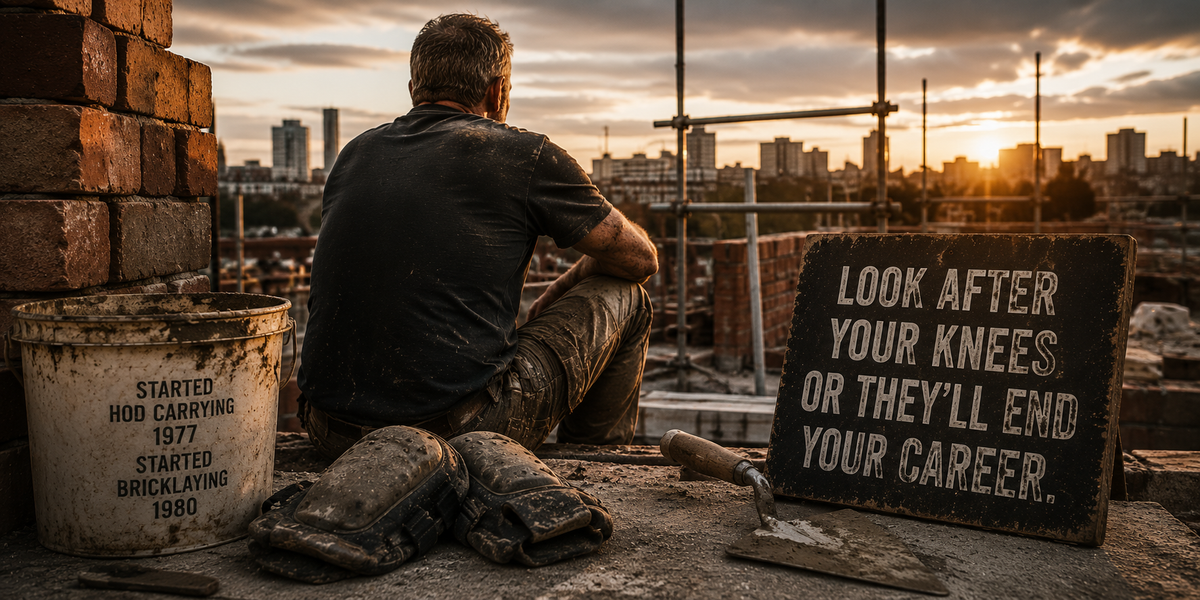
A 63-year-old bricklayer left a comment on this channel last week. He said: "I started hod carrying in 1977. I'm nearly done." No pension. No sick pay. Just knees that have finally had enough. If you're on the tools and you're under 40 — this is the conversation nobody had with him at 25. Read it now, or learn it the hard way in 30 years like he did.
The Comment That Started This
The full comment read: "At 63 ive nearly had enough… started hod carrying 1977, started bricklaying 1980." That's 47 years carrying weight, kneeling, bending, twisting. The industry made everyone self-employed back in 2010 — no holiday pay, no pension, no job security. When your knees go, you're done. You don't get recuperation time. You don't get a desk job to see you through to state pension age. You just stop earning.
He's not the only one. There's a reason research shows construction workers face roughly three times the risk of knee osteoarthritis compared to the general population. The work destroys cartilage. Kneeling on concrete, sharp twisting movements on uneven ground, repetitive loading through one leg while you adjust your balance on scaffold — every single day adds up. By 50, half the brickies you started with are talking about knee replacements. By 60, most of them are off the tools entirely.
The bloke who left that comment probably knows ten others in the same boat. What he doesn't know — what nobody told him in 1977 — is what you can actually do about it when you're still young enough for it to matter.
Why Knees Go First
Your knees are the biggest load-bearing joint in your body. They're designed to handle compression — standing, walking, climbing — but not designed to handle kneeling on hard surfaces for eight hours a day. When you kneel, your entire body weight gets concentrated onto a relatively small contact patch: your kneecap, the tendon below it, and the cartilage underneath. Do that repeatedly on concrete, brick, or timber and the cartilage starts breaking down faster than your body can repair it.
Add in the twisting. Bricklaying means you're constantly rotating at the waist while your foot stays planted — reaching for a brick, turning to butter the bed, pivoting to check your line. Every twist transfers force through the knee joint. If you're on uneven ground or half-turned on scaffold, that force goes through the joint at angles it wasn't designed for. That's how you tear a meniscus or strain an ACL without ever having a dramatic accident. One day you just feel a pop and now your knee doesn't track straight anymore.
Then there's the hod carrying, the labouring years most brickies come up through. Carrying 30-40kg up a ladder or across rough ground. Your knees absorb the impact every time your foot lands. Do that a few hundred times a day for three or four years and you've loaded your knees with forces equivalent to thousands of miles of running — but without any of the recovery time runners take between sessions.
The damage is cumulative. The body can repair cartilage and connective tissue, but only if you give it the raw materials and the rest windows to do so. Most blokes on the tools do neither. They work through soreness because taking a day off is a day's pay gone. They eat meal deals because there's no kitchen on site. They don't stretch because nobody taught them and they're knackered. By the time the knee actually hurts enough to stop them working, the cartilage is already significantly worn down.
What He'd Do Differently: The Practical Stuff
I tracked down a bricklayer called Alan, 61, who worked in Essex from the early 80s through to 2019. He lasted longer on the tools than most — packed it in at 58 when his right knee finally gave out after a partial meniscus tear that never quite healed right. He told me: "If I had my time again, I'd have switched knees every hour. Sounds daft, but I always knelt on my right. Every single bed, every course, 35 years. My left knee's fine. My right knee's bone on bone."
That's the first thing: alternate your kneeling leg. Most brickies develop a dominant side without realising it. You kneel on the same knee, pivot off the same foot, reach with the same arm. Thirty years of that and one side of your body is significantly more worn than the other. Switching deliberately — setting a timer on your phone if you have to — spreads the load. It feels unnatural at first. You'll be slower for a week or two. Then it becomes automatic and you've just bought yourself an extra decade on the tools.
Second thing Alan mentioned: knee pads that actually fit the work. He spent his first ten years either not wearing pads at all or wearing the cheap foam ones from the tool hire shop that disintegrate in three months. "I thought knee pads were for soft lads," he said. "Then I worked alongside a tiler who'd been in the trade 40 years and still moved like he was 30. He wore proper gel pads, the type that mould to your knee. I asked him about it and he said, 'I'm not hard, I'm just not stupid.' Wish I'd heard that at 25 instead of 45."
The pads worth wearing are the ones with a hard outer shell and gel inserts that distribute pressure across a wider area. They look over-engineered. They cost three times what the foam ones cost. They also last five years and actually stop your kneecap grinding into concrete eight hours a day. Tilers and carpet fitters learned this decades ago. Brickies are still acting like knee pads are a sign of weakness. That attitude costs you your career.
Third: stretching and mobility work, even five minutes. Alan didn't start stretching properly until his late 40s, by which point he was already managing chronic pain. "I'd get out of the van in the morning and my knees would be stiff for the first hour. I just thought that was normal. Then a younger lad on site — must've been about 30 — showed me a couple of stretches he did every morning. Hip flexors, hamstrings, calves, ankles. Took him five minutes. I started doing the same and within two weeks my knees stopped seizing up in the morning."
Tight hip flexors and hamstrings change the way force transfers through your knee. If your hips don't extend properly, your knee has to compensate. If your calves are tight, your ankle mobility is restricted and your knee takes up the slack. Stretching those areas — properly, not just a quick token effort — keeps your knee tracking correctly and reduces the grinding forces going through the joint. You don't need yoga. You don't need a gym. You need five minutes in the morning before you leave the house and two minutes at dinner.
The Stuff Nobody Talks About: Inflammation and Recovery
Alan also talked about what he ate, or didn't. "I lived on meal deals and bacon rolls for about 20 years. I didn't think it mattered. I thought if I was working hard, I could eat whatever. Then in my 50s I started getting blood tests done — my inflammation markers were through the roof. The GP told me it wasn't just my knees wearing out, it was my whole body on fire trying to repair damage I kept giving it."
Chronic inflammation makes everything worse. When your body's trying to repair cartilage and you're feeding it processed food, sugar, and oxidised fats, the repair process doesn't work properly. Your joints stay inflamed. The pain gets worse. The damage accelerates.
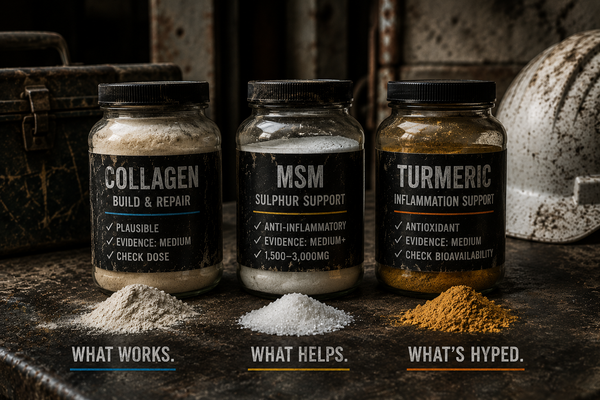
The basics that actually move the needle: more protein, more omega-3s, more vegetables, less processed rubbish. Protein gives your body the amino acids it needs to rebuild connective tissue — you're aiming for about 1.5-2g per kilogram of body weight if you're doing hard physical work. Omega-3s from oily fish reduce systemic inflammation. Vegetables provide the micronutrients your body uses to manage oxidative stress and tissue repair. After Shift contains 33g of protein per serving with added collagen — collagen being one of the specific building blocks your body uses to maintain cartilage and tendons in joints. It's not a magic fix, but it's giving your body what it actually needs rather than forcing it to repair damage with bacon and Lucozade.
Sleep is the other part nobody talks about. Alan averaged five or six hours a night for most of his working life. "I'd get home, have a few beers, watch TV, go to bed too late, get up at 5am. I thought sleep was something you did when you retired. Turns out your body does most of its repair work while you're asleep. I was basically working flat out and never giving my body time to fix itself."
Research on sleep and musculoskeletal recovery shows that inadequate sleep increases inflammatory markers and reduces the body's ability to repair tissue damage. You're not going to get eight hours a night every night when you're self-employed with an early start. But the difference between five hours and seven hours is significant. That's two extra hours of repair time every single night. Over a year, that's 730 hours. Over a decade, that's 7,300 hours of additional recovery your body gets. That's the difference between limping off site at 55 and still working at 65.
When Pain Becomes a Different Problem
There's a difference between knees that ache at the end of a long week and knees that are legitimately injured. Most blokes ignore both, which is how you end up turning a manageable problem into a career-ending one.
Alan tore his meniscus — the cartilage disc that cushions your knee joint — in his mid-50s. He was stepping backwards off a pallet, twisted slightly, and felt something give. "It wasn't agony," he said. "It was just a weird feeling, like something had shifted. I kept working. By the end of the day it was swollen and I couldn't bend it properly. I took the weekend off, iced it, and went back in on Monday. Probably the stupidest thing I ever did."
A meniscus tear doesn't heal the way a muscle strain does. The meniscus has very limited blood supply — only the outer edges get enough blood flow to repair naturally. If you tear the inner part and you keep loading it, you just make it worse. Alan worked on that knee for another three years, during which time the tear got worse, the joint became unstable, and he developed arthritis in the same knee from the abnormal wear pattern. By the time he finally saw a specialist, the damage was too far gone for a simple repair. He needed a partial meniscectomy — they cut out the damaged bit — which left him with less cushioning in the joint and arthritis that progressed faster.
If he'd stopped for two weeks when it first happened, got it scanned, and had it treated properly, he might still be working now. Instead, he's 61, can't kneel, and the industry he gave 40 years to has no pension for him because he was made self-employed right when he should've been building up a workplace scheme.
The signs that mean you need to actually stop and get it checked:
- Swelling that doesn't go down overnight. Normal soreness improves with rest. Swelling that persists means something's damaged.
- Locking or catching. If your knee occasionally gets stuck and you have to straighten it or wiggle it to get it moving again, that's a loose bit of cartilage or a meniscus tear. Ignoring it makes it worse.
- Instability or giving way. If your knee feels like it might buckle when you step down or twist, that's ligament damage. Keep working on that and you'll turn a partial tear into a complete one.
- Pain that wakes you up at night. Daytime pain is one thing. Night pain means significant inflammation or structural damage. Your body's trying to tell you something's seriously wrong.
The self-employed reality is brutal. Every day you take off is a day you don't get paid. But two weeks off now might save you from being forced off the tools entirely in five years. It's not about being soft. It's about being smart enough to stay working.
The Financial Angle Nobody Prepared Him For
Alan told me the thing that really drove him nuts was realising, too late, that he could've claimed industrial injuries benefit for his knees. "I didn't know it was a thing," he said. "I thought compensation was for people who'd had an accident, like falling off scaffold. I didn't realise that if you've got knee osteoarthritis and you've worked in construction for 20 years or more, you can claim through the Industrial Injuries scheme. Found out about it two years after I'd stopped working. Would've made a difference."
The UK's Industrial Injuries Advisory Council specifically recognises occupational osteoarthritis of the knee in workers who've spent significant time kneeling. If you've worked in a job that required regular kneeling or squatting for at least 20 years and you've been diagnosed with knee OA, you might be eligible for Industrial Injuries Disablement Benefit. It's not a fortune, but it's something — and it's recognition that the work did this to you, not just bad luck or getting old.
Most brickies don't know this exists. Most GPs don't mention it. You have to ask. You have to get your knees properly assessed and documented. You have to prove the link between the work and the condition. But if you've given 20, 30, 40 years to the trade and your knees are wrecked because of it, it's worth knowing you're entitled to something.
Alan wishes someone had told him that at 50, when he first started getting serious pain. He wishes someone had told him to get his knees documented, to keep records, to start the claim process while he was still working. Instead, he found out by accident on a forum two years after he'd packed it in, and by then half the evidence he needed was harder to pull together.
What It Means for Lads Still in Their 30s and 40s
If you're reading this and you're under 40, you've still got time to do something about it. Your knees probably already ache after a long day. You probably already feel stiff in the mornings. You probably think that's just what happens when you work hard.
It is what happens. But it doesn't have to be as bad as it is. The blokes who make it to 60 still working aren't lucky — they're the ones who switched knees, who stretched, who wore proper pads, who ate enough protein, who slept more than five hours, who saw a physio when something felt wrong instead of waiting until it was too late.
Alan's last piece of advice: "Tell the younger lads it's not about being soft. It's about still being able to work when you're my age. I'm 61. I'm fit enough to work. I've still got the skills. But my knees are gone and nobody's going to employ a bricklayer who can't kneel. I've got seven years until state pension and no income. If I'd looked after my knees properly, I'd still be earning. That's the reality nobody tells you when you're 25 and indestructible."
Frequently Asked Questions
Can construction workers claim compensation for knee osteoarthritis in the UK?
Yes. If you've worked in a job requiring regular kneeling or squatting for at least 20 years and you've been diagnosed with knee osteoarthritis, you may be eligible for Industrial Injuries Disablement Benefit through the IIAC scheme. You'll need medical evidence linking your condition to your occupation. Most tradesmen don't know this exists — ask your GP about the assessment process and start documenting your knees now, not after you've already stopped working.
What's the difference between normal knee soreness and an actual injury that needs treatment?
Normal soreness improves overnight and responds to rest. Warning signs of actual injury include: swelling that persists for more than 24 hours, your knee locking or catching when you move it, instability or feeling like it might give way, and pain severe enough to wake you at night. If you've got any of those, get it checked properly. Two weeks off now beats being forced off the tools permanently in five years.
Do knee pads actually prevent long-term damage or just make kneeling more comfortable?
Proper knee pads — the ones with hard shells and gel inserts, not cheap foam — reduce peak pressure on your kneecap and distribute load across a wider area. That measurably reduces cartilage breakdown over time. They're not just comfort, they're injury prevention. Tilers who've worn good pads for 30 years have visibly better knees than brickies who went without. The pads that work cost £40-60 and last five years. The alternative is a knee replacement at 58.
Which trades are hardest on your knees?
Tiling, carpet fitting, and bricklaying are the worst for sustained kneeling. Roofing and scaffolding involve less kneeling but more loading through one leg on uneven surfaces, which increases ACL and meniscus injury risk. Labouring and hod carrying put massive repetitive impact through the knees. Realistically, if you're in any construction trade, your knees are taking more punishment than the average office worker's — the question is whether you're doing anything to manage it.
At what age should I start worrying about my knees if I'm a tradesman?
Start managing them now, whatever age you are. Most knee damage is cumulative — it's building up in your 20s and 30s even if you don't feel it yet. By your 40s you'll start noticing stiffness and soreness. By your 50s it's limiting what you can do. The blokes still working pain-free at 60 started looking after their knees in their 30s, not when the damage was already done. Alternate your kneeling leg, wear proper pads, stretch daily, eat enough protein, and don't ignore swelling or instability.